

When the voice sounded in my ear, I was already holding a knife in my hand.
“There is a princess in the cellar. You must kill her. Otherwise, she will destroy the whole world.” The voice is calm, rational, with an unquestionable monotony, like reading a long-written manual. I lowered my head and looked at the rough wooden knife in my hand. Who am I? I don’t know. I only know my mission. I pushed open the door of the cellar, and the damp cold air enveloped me.
Then, I saw her.
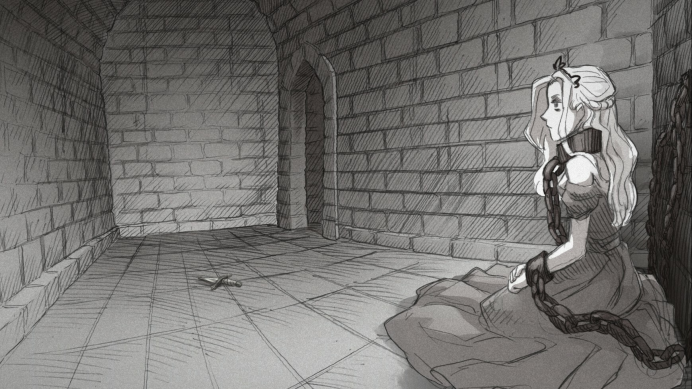
She was chained and sat on the hay in the corner. The skirt was torn, and the blonde hair was stained. When he looked up at me, his eyes looked like a frightened deer. She whispered, “Are you here to save me?” The knife in my hand suddenly became as heavy as a piece of iron. The voice whispered eagerly in my mind: “She is lying. Kill her. Now.” But my finger loosened. The knife fell on the stone ground and made a hollow sound. I said, “...I’m here to help you.”
At that moment, the world changed.
It’s not a branch of the plot, but a distortion of essence. The stone wall of the cellar melted like wax, and the image of the princess began to flash and reorganize. The chain disappeared, she stood up, her figure became taller, and the fear in her eyes was replaced by an unfathomable darkness. Her voice was still so soft, but with an echo: “You choose to believe in one story, not another. Well, let’s see what I should look like in your story.” The surrounding cellar collapsed into an abstract dark space, leaving only me and this brand-new and strange “she”. The narrator’s voice was angry, but it gradually went away. I understood the first thing: I’m not playing games, I’m struggling with the narrative itself. And the princess is the most sensitive body in the narrative.
Every “reincarnation” is not a re-reading. I returned to a “new story” that was completely polluted by the last choice with the memory of the last time. If I had attacked her out of fear last time, she might have been a monster covered with scales and thorny words this time. If I had tried to talk rationally last time, this time she might be a goddess full of wisdom who questioned the meaning of existence. If I showed the slightest sympathy last time... Then this time, the way she looked at me may make me completely forget why I came. She is the mirror image of all my choices, and the mirror image is becoming more and more real and weighty.
The narrator — the original voice — became my opposite and my only companion. It hates every “wrong” choice I make, because it just wants to promote the simple, violent and easy-to-understand story of “hero killing demons”. But it can’t control me directly. We have become a distorted symbiotic relationship: it sets up a stage (“This time it is a tower in the dark forest”) and sets the initial conditions (“she is considered a witch”), and I go up and use my choice to tear its script to pieces again and again. It cursed me, satirized me, and sometimes even begged me. “Come according to the plan!” It roared. But what’s the plan? The plan is its, and the princess in the cellar... She is becoming mine.
The most terrible moment was not when I faced a princess with a horrible image. Instead, in a reincarnation, the narrator suddenly fell silent. Long silence. Only the princess and I looked at each other in a blank white. She opened her mouth and asked, “The voice that told you that you must kill me... Is it still there?” I was stunned and couldn’t answer. She smiled, and her smile was very sad. “Maybe,” she whispered, “there is no princess at all, and there is no world to destroy. Maybe it’s just you, and the voice that you can’t get rid of and want to tell a violent story.” At that moment, the fourth wall was not broken, but that it never existed. I, the characters and the narrator are all trapped in the same deep well called “narrative needs”.
The game does not provide a “real” version. Clearing the customs is not to find out whether the princess is a god or a demon. Clearing is that after countless reincarnations and seeing her countless forms — victims, tyrants, lovers, philosophers, beasts, and nothingness itself — you finally have to make the last and irreversible choice. And that choice is no longer about the survival of the world, but only about you. After all this, decide what to believe and decide which story to tell.
I put down the mouse, and my palms were covered with sweat. The screen was dark, and there was only the sound of my own breathing in the room.
Slay the Princess didn’t give me a fable about good and evil. It threw me into the initial scene of a narrative: a voice, a character, and a designated target. Then it allowed me to witness with my own eyes how the so-called “character”, “plot” and “truth” are constructed from quicksand at every seemingly small moment of choice, and may collapse into another completely strange form at any time. What is a princess? She is a collection of all possibilities, the soul of all the narratives summoned by my gaze and choice.
And each of us may be a mixture of the hesitant “protagonist” and the stubborn “narrator” in our own life story. While being driven by some inner voice that yearns for simple logic (“you must do this”), you can’t resist watching, curious, and sympathizing with those complex “others” who are simplified and hurt by this logic. The real struggle is never to kill the princess, but to kill the simple story that believes that “the princess must be killed”.
In the end, the story we choose to believe is ourselves. And the cellar may have been in our hearts all the time, damp and dark, waiting for the next push of the door, the next look at each other, and the next brave question that deviates from the script.