

When I opened the wooden door, I heard the sound of a pencil reaming the paper.
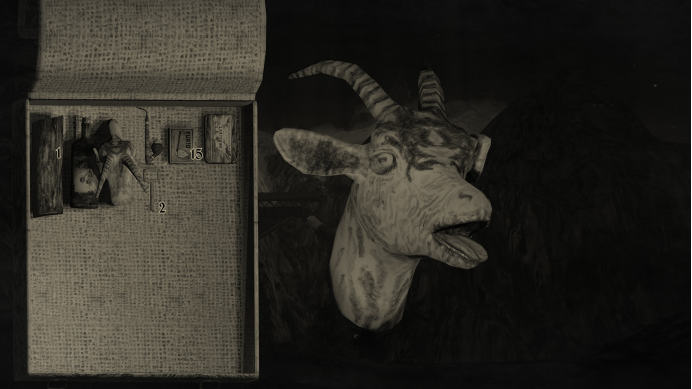
It is not a sound effect, but a real rustle. It’s just as dry as I drew as a child with a bare 2B pencil on the back of the sketch paper. The entire screen is black and white, but not black and white as in the photo. It is actually drawn with a pencil — the shadow of the mountain is piled up by countless short oblique lines, and the texture of the paper itself can be seen in the white area of the snow. The character I controlled returned to a small village in the Alps to find out the truth about my grandfather’s death. But the first thing I felt was that the cold had a texture: rough, irregular, like a sketchbook that has been painted repeatedly and a little hairy.
The road is crooked. I pressed the forward button, and the character went up the slope. The steps left a small mark on the image. It was not a footprint, but a track that had been erased and not cleaned. The edges of the shadows projected through the pine trees are blurry, and some lines are too heavy, as if the painter’s hands are shaking. Such an image will not make you forget that you are gaming. Always remember that you are looking at an unfinished painting, and the hand holding the pencil seems a bit uncomfortable.
The first person I met was under the eaves of the barn. His face consists of five lines: one curve is the edge of the hat, two points are the eyes and a fold line is the closed mouth. As I got closer, the position of his lips began to tremble. It was not an animation, but the line itself trembled slightly, like a painter hesitating to draw that expression. The dubbing is a low dialect whisper, mixed with the continuous chatter of pencils in the background. I can’t understand what he’s saying, but I understand that he says “don’t disappear”. When the picture itself is full of uncertainty, even the warning becomes a guess.
The way to solve the puzzle is just as simple as the painting style. Not looking for the key, looking for the right line. One door is locked. I have to remember the graffiti on a certain page in my grandfather’s diary — not the content, but the weight of the lines. I remembered that the word ‘fear’ on that page was repeatedly bold, and the ink almost penetrated the back of the paper. So I asked the character to take the pencil out of his pocket and draw the same thick shadow around the door lock. The lock did not “click” open. He slowly melted into the shadow of these new paintings and disappeared, as if he had never been part of the statue.
When monsters appear, the world begins to change itself. It was just a tangle of crisscrossing lines on a distant hillside when it all began. When I retreated, those lines came to life, like someone chasing with an eraser, knew paths, road signs and all the signs that could identify directions. I ran to a small house and closed the door. Through the doorway I saw that the sky outside was covered with a large area of side leaves — it was not dark, but black. The deepest fear is not to be caught, but to have the feeling that you will also be adjusted or erased at the next stroke.
But the world of pencils has its strange tenderness. Under the chapel altar I found the last note my grandfather had left. Paper is the only clean thing in the game. The handwriting is just as light as when the pencil is almost finished. I have to put my face close to the screen and almost stick it to see the short sentences about the wind, the flock and the apology. When I looked up, I discovered that the colored windows of the church were half dark — to show me the words clearly, the screen took the initiative to make me darker.
At the end of the game, the truth was not spoken in words. The photo cuts back to the snowy slope where my grandfather fell, but this time I’m the one holding the pencil. The game asked me to complete the painting: add his last footprints on the edge of the cliff, compensate for the thickness of the clouds that day in the sky and add the angle when he fell in the shadow of the snow. Every time I sign a stroke, I understand a little more — not to understand why he died, but to understand how cold the wind was that day and how hard the snow was, and to understand that a person at the end of the wrist was shaking before it became a permanent line in the image.
When I went through customs, I sat in the dark, with my hands firm and loose. The list of producers that rolls across the screen is also handwritten, with different manuscripts, some clean and others scribbled. The last line says “When I draw this picture, the mountain is snowing outside the window”.
I got up, turned on the light and saw the sketchbook on my desk, which was a half-painted street corner café last week. The lines are very light, as if they are afraid of injuring the paper. I sat down and picked up the pencil again.
This time, when the tip of the pen fell, I suddenly understood the sound of zippers — it was not fear, but someone who drew the dreaded thing seriously, repeatedly, until it finally became able to look directly.
The so-called truth may never be the signed part. It is the rhythm of the painter’s breathing, the careful white space between the lines and the small vibration that not everyone can see, but can feel when the wrist hangs in the air.