

The first time I fell down was not because of the stone, but because the rhythm was broken.
The wind comes from the left, with rain, every three seconds. The Moira I control is running in the gap between the wind and rain, like sneaking through the breath of a giant. The left foot stepped on the moment when the wind stopped; the right foot fell on the drumming of the raindrops hitting the stone. Then I was distracted — I took a closer look at the seagull under the cliff — and my steps were confused. The rock suddenly became slippery, and the hillside tilted back. Moira rolled down, and his blood volume dropped a little. I lay in the mud and suddenly laughed. This game teaches not jumping, but listening. Listen to the rhythm of this mountain.
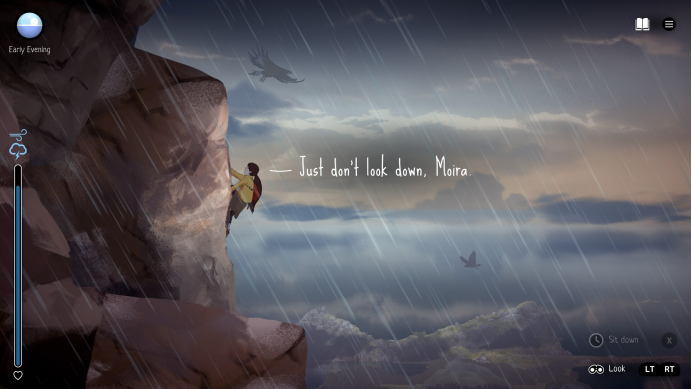
The game is called A Highland Song. Moira, a girl, is going to cross the Scottish Highlands and go to the beach to meet her uncle whom she hasn’t seen for many years. There is no map. There is only the distant coastline and the ever-changing mountains underfoot. You have to find your own way: follow the deer’s footsteps, cross the ridge that seems to be passable, and explore on the edge of the swamp. Walking the wrong way is not a failure, but a discovery. I was trapped under a cliff for half an hour. When I was about to read the file, I found an ancient stone step covered with moss hidden in the crevice. It does not lead to the “right” road, but leads to an abandoned star viewing platform and a memory of Moira’s grandfather.
Those memories are the real signs in the game. Touching a weathered stone tablet, the world will fade into a black-and-white image decades ago. The young grandfather sheltered from the rain here and had a fire there. These memory fragments do not advance the plot. They are like scattered magnets, slowly absorbing the abstract word “family” into a concrete existence with temperature and smell. Running is no longer just a way. It has become a geographical ritual to reproduce the footprints of elders with the body.
But the highland is alive, and it is unkind. The weather is changing rapidly. One second it was a golden meadow in the sun, and the next second it was the fog that swallowed everything. The visibility drops to the feet, and the only guide is the sound: the direction of the stream in the distance, the faint sound of sheep bells in the wind. I learned to run with my eyes closed — I used my ears to judge where is solid land and where is dangerous gravel slope. Sometimes the thick fog is too long, and Moira will shiver with cold, and frost will form on the edge of the screen. At this time, find a cave to make a fire. The kind of comfort from the inside out is more real than any upgrade reward.
The most shocking moment happened on the seventh day. I came to a huge hill, and the game prompted: “Feel the pulse of the mountain.” I stopped and didn’t press anything. On the screen, Moira’s breathing rhythm gradually synchronized with the background music. The wind, the thunder in the distance, my own heartbeat — they closed. Then, luminous footprints began to appear on the ground. It was not a path, but a string of light spots that disappeared with the frequency of my heartbeat. I followed it, not with the arrow keys, but with the keys to fit the beat of the heartbeat. In those five minutes, I was not playing a game. I was being a part of this song. When I reached the top of the hill and saw the whole sea unfolding in the sunset, I got goosebumps all over. It’s not brought by the beautiful scenery, but a kind of more primitive resonance: it seems that my running really added a note to this mountain just now.
At the end of the game, Moira finally met her uncle. There was no grand reunion, only two people sat by the campfire and shared the food in their bags. The uncle talked about why he left at that time, and the reason was so ordinary that it made people feel lost. Moira also talked about the places he saw along the way and those places in his grandfather’s memory. “They have changed a little,” she said, “but the wind is still the same.”
I quit the game, and the city outside the window was still noisy. But my ears seemed to be opened, and I could distinguish the rules in the sound of the external air conditioner, the tremor of the subway in the distance, and the running interval of the children upstairs. We walk through countless rhythms every day, but never listen.
A Highland Song is not a mountaineering simulator. It is a fable about “how to resonate with something much bigger than itself”. Isn’t our life a highland crossing? There is no ready-made map, only the direction you can hear. We will fall down at the wrong pace and be trapped by the thick fog. At some unexpected moment, we will suddenly resonate deeply with the memory of a family and the pulse of a piece of land.
Perhaps, growth is the final realization: the important thing is not which coast you arrive at, but your footsteps, whether you have been gently combined with the ancient and magnificent rhythm of the world in an instant. Even if it’s just one step.